Planning changes raised LeWM’s success rate from 22% to 85% in simulation
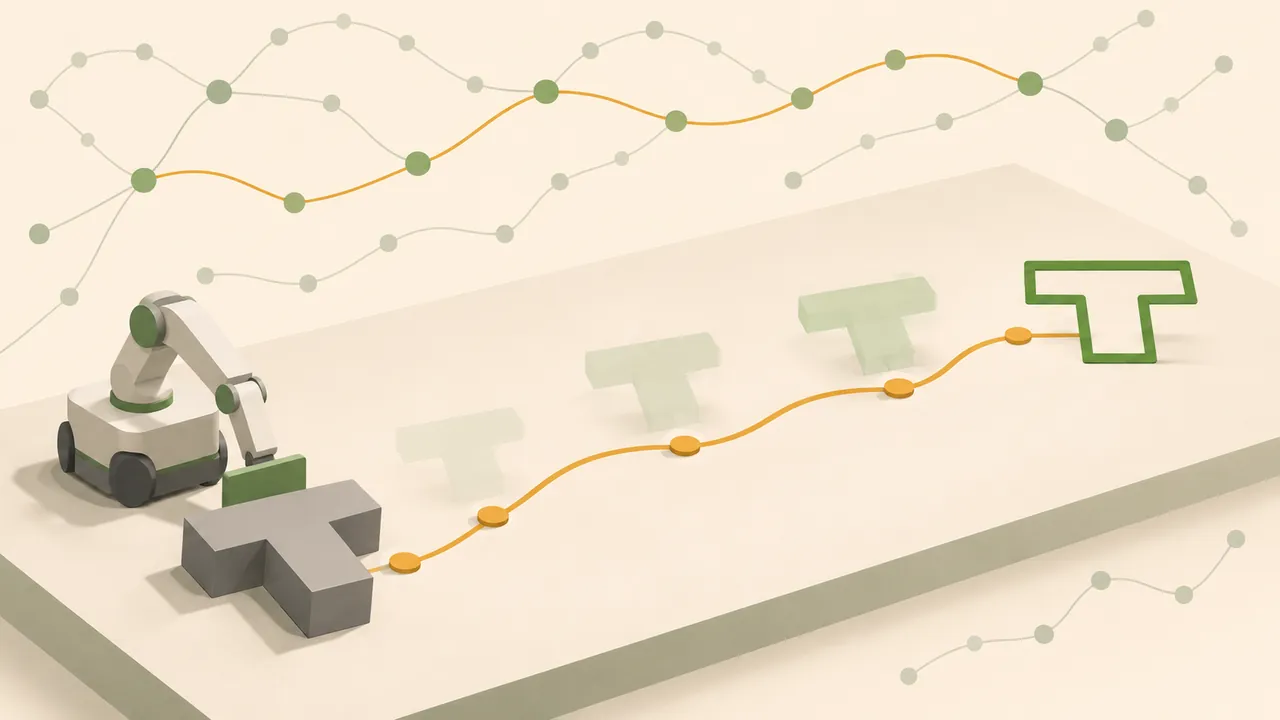
The author of haddyalchaer.com described 600 experiments with LeWM, a JEPA world model released by a team including Yann LeCun. The tests used Push-T, a simulation in which a robot pushes a gray T-shaped block into a green target position specified by a goal image.
JEPA encodes observations as compact vectors called embeddings. A predictor estimates the next embedding given an action, while a planner searches action sequences for one that brings the predicted state closest to the goal. For goals 25 steps away, LeWM succeeded 89.7% of the time, compared with 90.5% for a version using the simulator’s exact physics. At 75 steps, the original LeWM setup succeeded in just 22% of cases.
The author split longer plans into subgoals roughly 25 steps apart. To obtain these without an expert demonstration of the particular solution, the author built a graph of about 460,000 embedded states from LeWM’s training demonstrations. It linked successive states within demonstrations and nearby states across different demonstrations.
The initial graph search produced physically impossible routes by chaining jumps between demonstrations. Adding a cost to every such jump raised success from 62% to 85% on the same 250 tasks with goals 75 steps away. According to the author, segmentation and graph-based planning together lifted the original 22% result to 85% without retraining, matching a planner supplied with expert subgoals.
Original source: haddyalchaer.com ↗
Comments on source platforms
Rank is the maximum of the latest discussion counts. These are source metrics.
Hacker News
- Discussion ↗: 46
Measured: 14 Nov 2026, 17:00 UTC