Researchers link minute-by-minute grid pulses to UPS battery checks
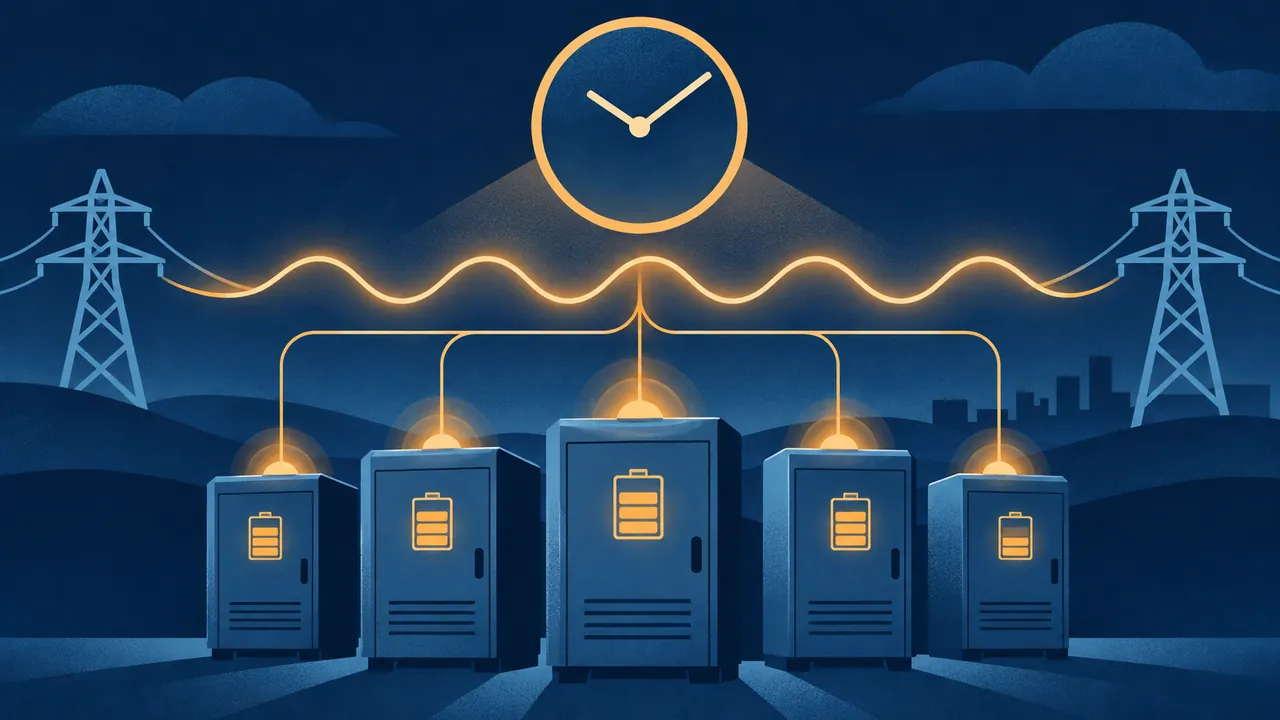
A team led by physicist Dirk Witthaut at the University of Cologne has proposed an explanation for pulses observed for more than a decade in physically separate electricity grids. Every 60 seconds, the current frequency shifts slightly before returning to normal. The effect has been detected in continental Europe, Britain, North America and Australia, among other regions. The findings were published in Nature Energy.
The researchers analyzed high-resolution electrical measurements from buildings at Forschungszentrum Jülich in Germany. They found the minute-long pattern in four buildings equipped with uninterruptible power supplies (UPS), but none of the examined buildings without those systems showed it. In one building, they traced the fluctuations through its electrical infrastructure to the connection with the public high-voltage grid.
A manufacturer confirmed that automatic battery self-tests, triggered by the systems’ management software, caused the observed pulses. The researchers suggest that devices synchronizing their clocks with external time signals could perform these checks simultaneously despite operating independently. Small demand spikes from enough devices could then combine into a measurable frequency fluctuation across a grid.
According to the researchers, the fluctuations currently pose no immediate threat to grid stability and typically have an amplitude of only a few millihertz. For large batteries and backup systems, adding small random variations to test schedules could prevent devices from drawing power at the same moment.
Original source: habr.com ↗
Comments on source platforms
Rank is the maximum of the latest discussion counts. These are source metrics.
Хабр
- Discussion ↗: 25
Measured: 11 Nov 2026, 11:00 UTC