University of Tokyo tests robot legs with 3D-printed muscles
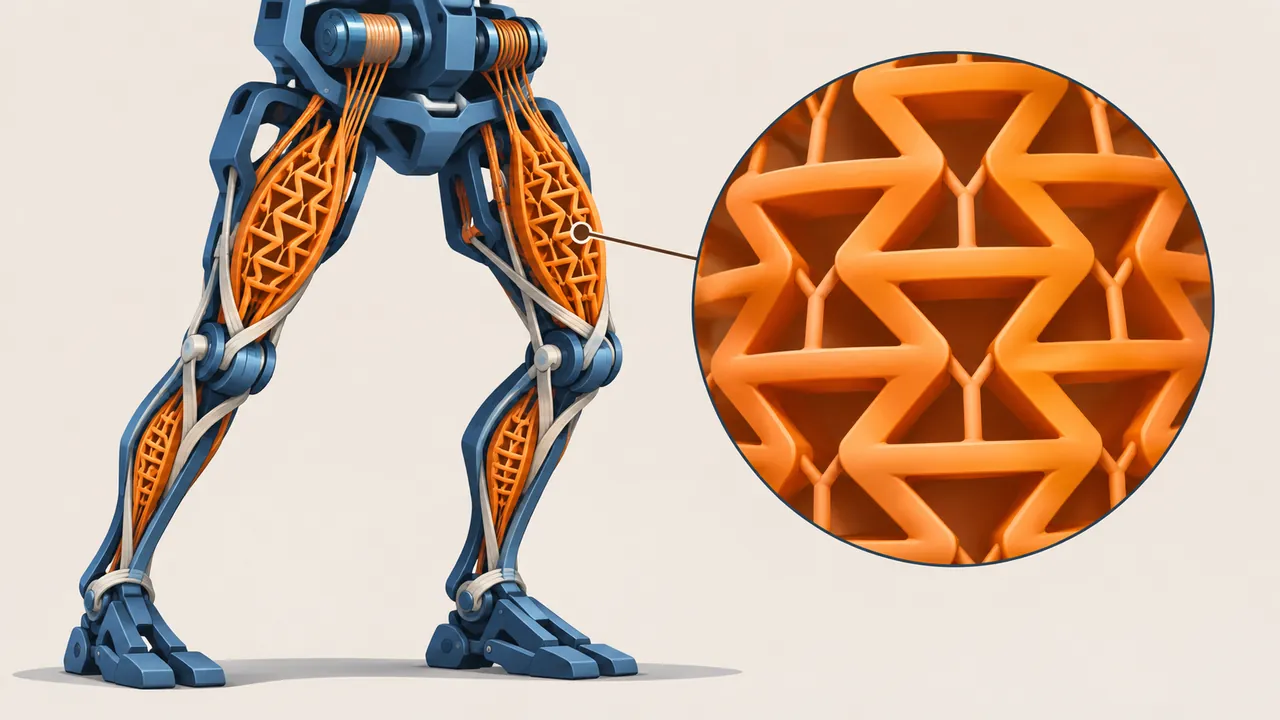
University of Tokyo researchers have presented a method for 3D-printing artificial muscles and tested it on robotic legs. All flexible components were printed from TPU 95A thermoplastic polyurethane on a Prusa XL, while the frame used PLA. Increasing the thickness of the internal lattice struts from 1.5 to 3 mm increased stiffness 28-fold. The approach also allows a soft muscle and a stiffer tendon to be printed as one component.
Each leg contains six large artificial muscles. Some act on two joints at once, such as extending the hip while bending the knee. To move just one joint, other muscles compensate for the unwanted motion. Motors around the pelvis pull the muscles through cables, while ligaments hold the joints together and constrain their movement without bearings.
During contraction, the muscle lattice folds inward, producing little sideways expansion and avoiding interference with neighbouring components. Printing one full-size muscle takes 20–40 hours, with cable channels incorporated during printing. The method requires no casting and reduces manual work.
In experiments, the robot performed movements with step lengths of 0.4 and 0.8 metres, with a suspension supporting part of its weight. Samples survived 999 loading cycles without tearing, although their stiffness changed over time. The researchers next plan to apply the approach to full-size humanoid robots with complete bodies and integrated sensors.
Original source: habr.com ↗
Comments on source platforms
Rank is the maximum of the latest discussion counts. These are source metrics.
Хабр
- Discussion ↗: 2
Measured: 14 Nov 2026, 05:39 UTC