ULC codec brings stereo audio to Nintendo 64 at about 4% CPU usage
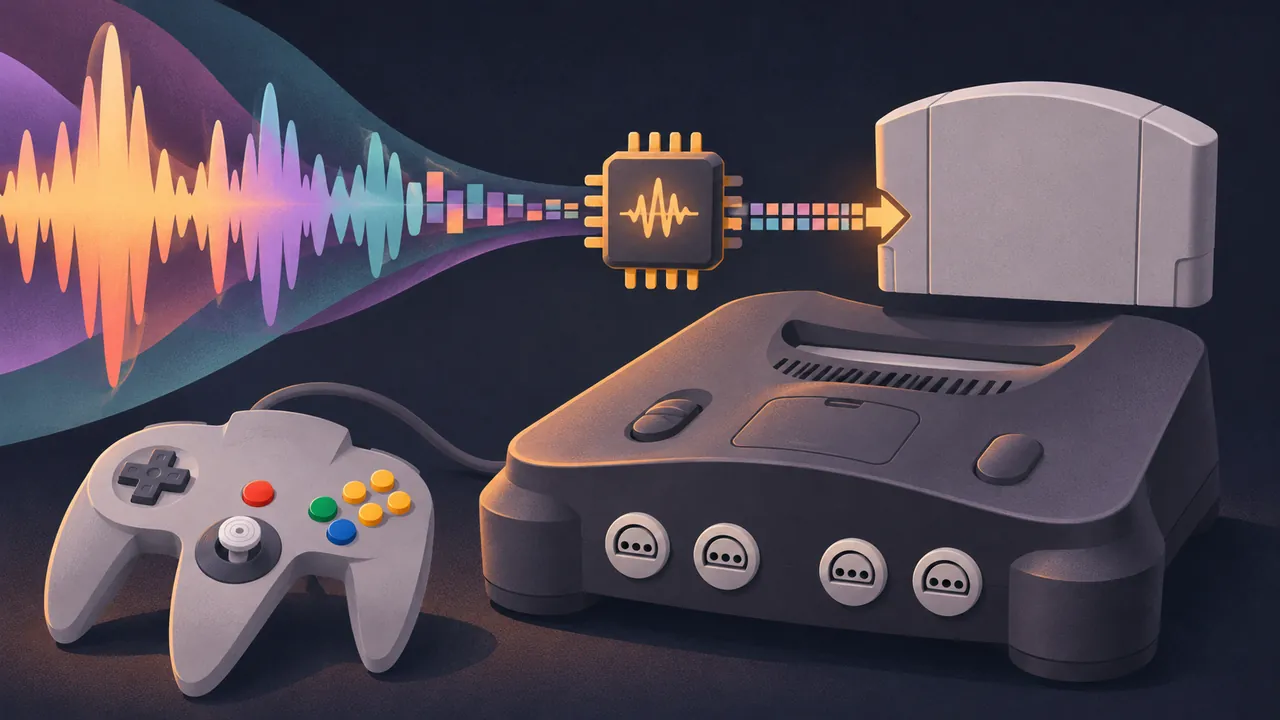
The Ultra Low Complexity Codec (ULC), created by developer Aikku93, has been adapted for Nintendo 64. Its decoder has been merged into the preview branch of the open-source Libdragon library and works through its existing audio interface. The adaptation’s author describes it as suitable for background music, speech, ambience and longer sound effects during gameplay.
ULC uses a modified discrete cosine transform but avoids entropy coding, storing coefficients through a simple nibble-based scheme. Aikku93 has developed the codec since 2019, and its code is permissively licensed. According to the adaptation’s author, its quality and bitrate approach those of Opus, while its computational complexity is roughly four times that of ADPCM.
Fitting the decoder onto the console required switching to 16-bit fixed-point arithmetic and moving the inverse transform to the RSP coprocessor. Around 1,400 lines of MIPS assembly also handle block lapping, stereo interleaving and output scaling. The resulting code barely fits within the RSP’s 4,096-byte instruction memory.
The codec already has a practical application. According to the README for a recently published Nintendo 64 port of Half-Life, Libdragon’s ULC support allows its 2,500 sounds and 27 music tracks to fit into a single 64 MB cartridge image.
Original source: phoboslab.org ↗
Comments on source platforms
Rank is the maximum of the latest discussion counts. These are source metrics.
Hacker News
- Discussion ↗: 30
Measured: 6 Nov 2026, 17:57 UTC