Deep-TEMPEST uses AI to reconstruct screen content from HDMI emissions
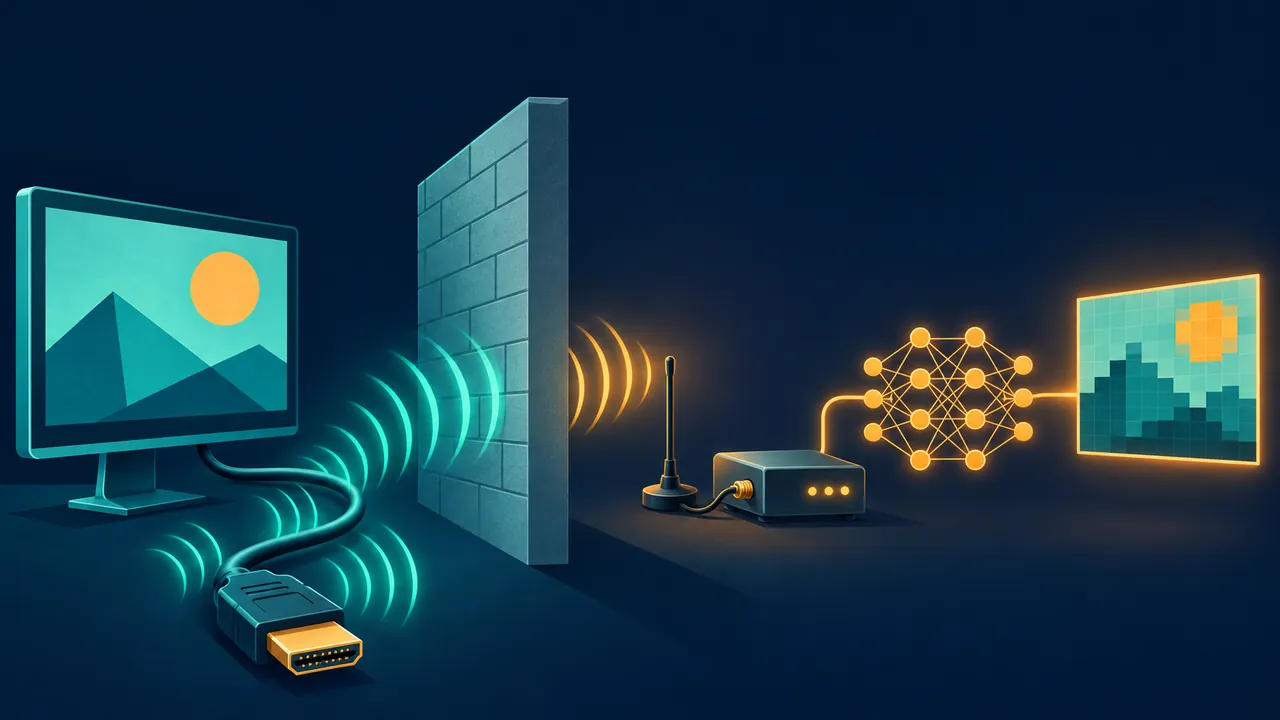
Deep-TEMPEST uses deep learning to reconstruct computer screen content from electromagnetic emissions produced by standard HDMI cables. According to a report on habr.com, interception can work through walls, with an observer near the room using an antenna and a software-defined radio (SDR). The method requires neither downloading files onto the target computer nor connecting to it over a network.
The project builds on traditional TEMPEST attacks, which intercept electromagnetic emissions from electronic equipment. The report explains that signals from older VGA cables were relatively easy to reconstruct using an oscilloscope. By comparison, HDMI’s high-frequency digital data streams previously appeared as unintelligible noise when intercepted over the air.
Researchers trained a neural network to process raw radio-frequency signals captured with an SDR. The model suppresses noise and converts weak radio emissions into raster frames while compensating for interference, cable shielding and distortions caused by distance.
The report claims that the reconstructed images provide readable text and distinguishable application windows in real time, and that neither the computer nor its owner can detect the passive interception. It lists cables with reinforced shielding, ferrite filters and enclosures certified to the TEMPEST standard as protective measures.
Original source: habr.com ↗
Comments on source platforms
Rank is the maximum of the latest discussion counts. These are source metrics.
Хабр
- Discussion ↗: 3
Measured: 13 Nov 2026, 08:46 UTC