Magnetic microrobots sped up clot dissolution in pig experiments
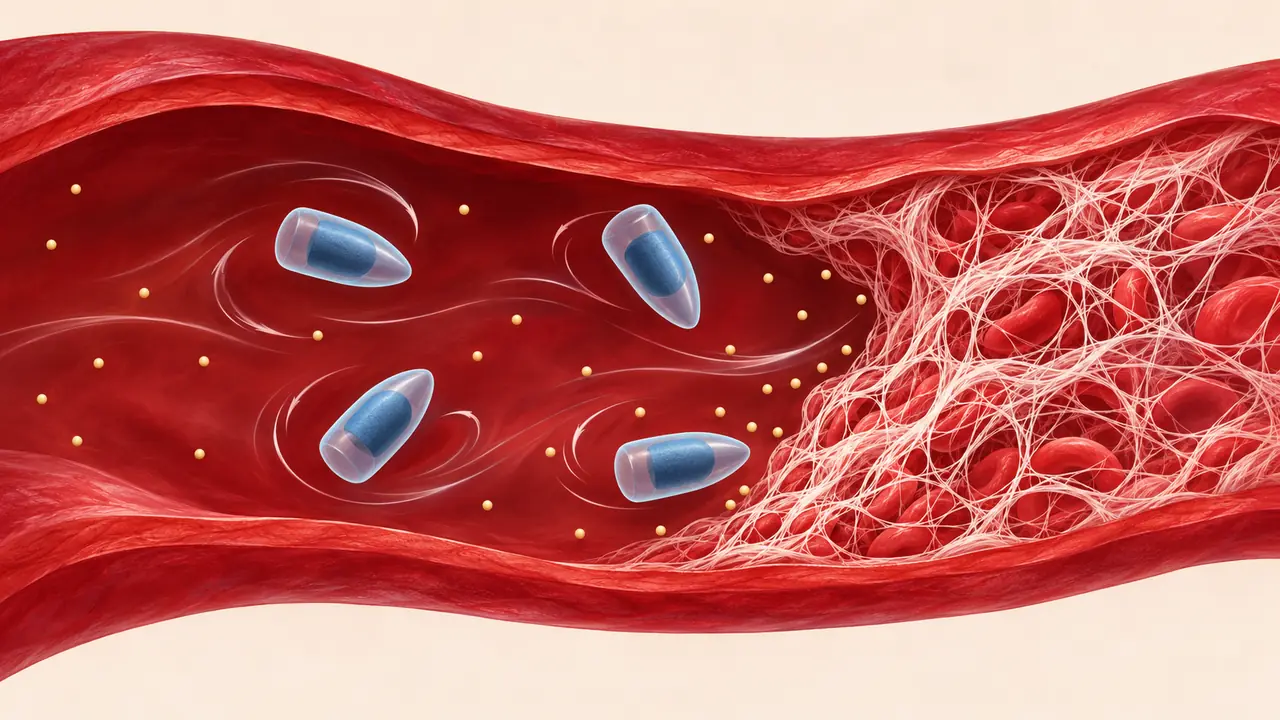
Researchers led by Simone Schürle, professor of medical microsystems at ETH Zürich, tested magnetically controlled microrobots to help deliver drugs to blood clots. In experiments involving clots created in pigs’ kidney vessels, treatment with the microrobots dissolved the blockages roughly twice as fast as drugs alone. The university announced the research on November 9; the findings have not yet been published in a peer-reviewed scientific journal.
Each bullet-shaped particle contains a magnetic framework of iron oxide nanoparticles enclosed in a protective polymer hydrogel shell. A rotating external magnetic field makes the microrobots tumble inside blood vessels. According to the researchers, this motion creates small vortices that help transport drugs directly to a blockage, addressing the difficulty of covering the final few millimetres.
In a silicone vessel model containing clots made from pig blood, the moving particles helped a clot-dissolving drug work approximately five to six times faster. Experiments using trypsin on artificial fibrin clots achieved a tenfold acceleration. These results came from different experimental settings.
The team is conducting further safety tests before potential human trials. Earlier mouse studies showed that the iron oxide and shell polymer broke down safely within several weeks, but safety still needs to be established in larger mammals. The latest pig experiment examined neither microrobot breakdown in the body nor the animals’ condition after the clots dissolved.
Original source: habr.com ↗
Comments on source platforms
Rank is the maximum of the latest discussion counts. These are source metrics.
Хабр
- Discussion ↗: 2
Measured: 19 Nov 2026, 22:12 UTC