CRAM study reports at least 1,000× faster training on puzzle tasks
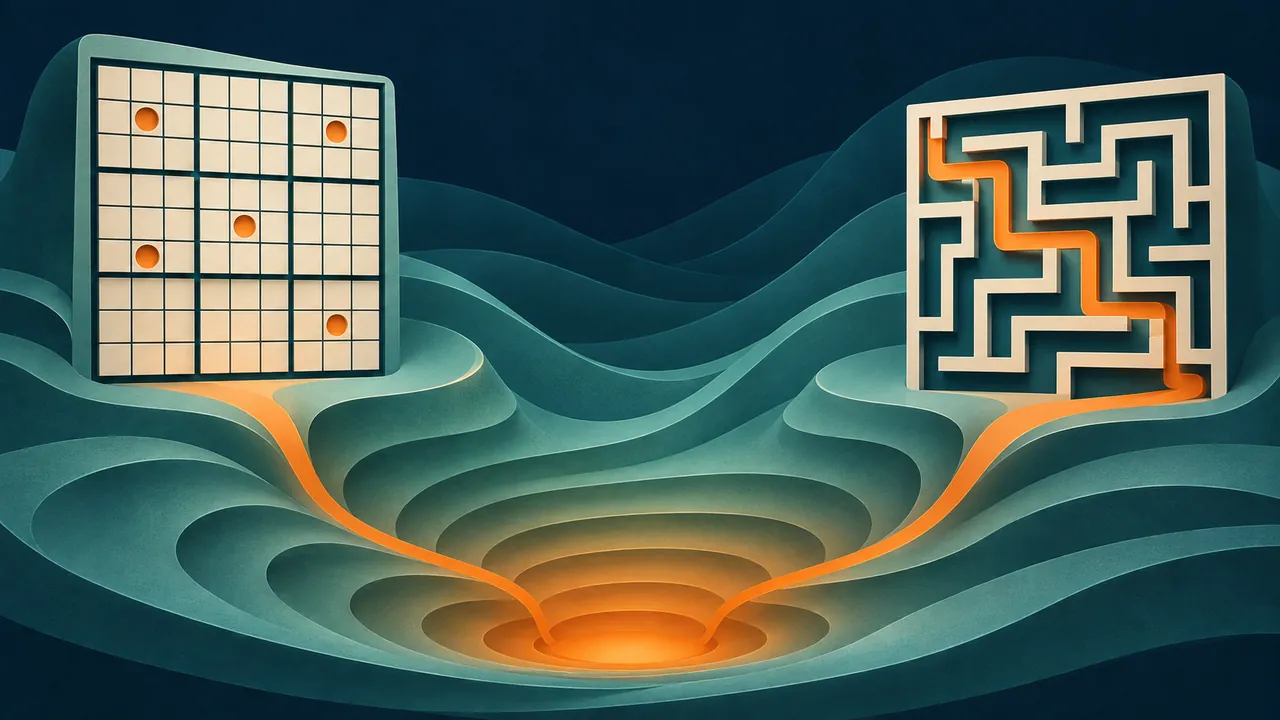
Researchers introduced CRAM, a learned version of Hopfield and Tank’s energy function from the 1980s, in a paper submitted to arXiv on November 12, 2026. The authors report training at least 1,000 times faster than looped models on Sudoku-Extreme and Maze-Unique.
CRAM solved 99.996% of Sudoku-Extreme test puzzles after 42 milliseconds of training on one GPU, and 100% of Maze-Unique test puzzles after 132 milliseconds. Those timings refer to training. On Sudoku-Extreme, CRAM also matched baseline looped models at their highest accuracy while using at least 282 times fewer floating-point operations during inference.
The approach uses descent on an energy function. The authors describe benefits including built-in early stopping, computation that adapts to problem difficulty, and fast training without differentiating through a solver. They also say its interpretable weights learn puzzle constraints. By comparison, they note that looped models can be unstable, slow to train and computationally expensive for simple puzzles.
The researchers view energy-based approaches as a promising direction for learning reasoning from data. They also caution against using easily solved benchmarks such as Sudoku and mazes to assess the scalability of looped reasoning techniques.
Original source: arxiv.org ↗
Comments on source platforms
Rank is the maximum of the latest discussion counts. These are source metrics.
Hacker News
- Discussion ↗: 1
Measured: 19 Nov 2026, 22:10 UTC